UCAREFFECT

Public works index · Snapshot 01

Hamdi Ucar public works and source index

Public posts and publication records are preserved as a searchable, source-attributed snapshot and linked to the experimental video index.

Platform metrics

Hamdi Ucar

@Sudanamaru1

X / third-party public snapshot

followers
2,118
views
174.7K
likes
1,223
comments
44

Papers / source-labeled totals

citations
24
reads
9,847
downloads
1,949
mentions
8

YouTube / archived item snapshot

subscribers
2,810
views
182.1K
likes
7,734
comments
1,287

Searchable archive

Public works

10 blog posts · 31 preserved X posts · 3 publication records

Showing 44 of 44 indexed works

X post
Original source

Simulation of the angular dynamics of a disk magnet with a 6° mfg misalignment in a rotating fie…

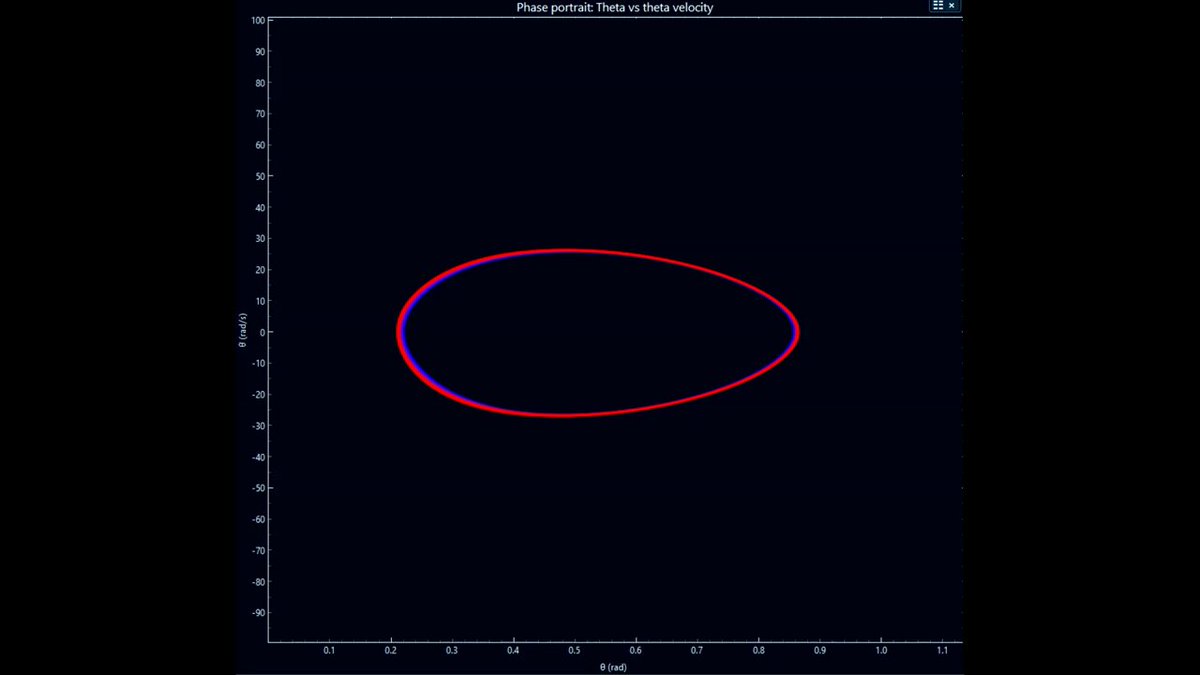
Simulation of the angular dynamics of a disk magnet with a 6° mfg misalignment in a rotating field. As it gains spin, the magnet enters a large-amplitude excited mode, similar to observ. in magnetic bound state experiments. The video shows this evolution through a phase portrait.

  • magnetic bound state
  • spin & angular dynamics
  • simulation & theory
Preview from Hamdi Ucar's public X post

Source-platform counters

views
375
likes
9
comments
1
reposts
0
Platform attention index38.4

Descriptive onlyType-relative · reach, engagement; not a measure of scientific quality or validity.

X post
Original source

An hourglass with a magnet glued to it slows down due to vibrations in a magnetic bound state. P…

An hourglass with a magnet glued to it slows down due to vibrations in a magnetic bound state. Polarity Free Magnetic Repulsion and Magnetic Bound State Symmetry 2021, 13(3), 442 https://doi.org/10.3390/sym13030442

  • magnetic bound state
  • polarity-free repulsion
  • translational locking
Preview from Hamdi Ucar's public X post

Source-platform counters

views
354
likes
8
comments
0
reposts
0
Platform attention index27.4

Descriptive onlyType-relative · reach, engagement; not a measure of scientific quality or validity.

X post
Original source

A new maglev scheme developed together with Daniel Paschall worked for the first time! The field…

A new maglev scheme developed together with Daniel Paschall worked for the first time! The field topology allows each “magnetic wheel” to move freely along the track while remaining locked to it. 2025/01/31. Symmetry 2021, 13(3), 442; https://doi.org/10.3390/sym13030442

  • maglev & track
Preview from Hamdi Ucar's public X post

Source-platform counters

views
519
likes
14
comments
0
reposts
3
Platform attention index58.4

Descriptive onlyType-relative · reach, engagement; not a measure of scientific quality or validity.

X post
Original source

We don’t need to be in space or in free fall to play with magnets floating in the air. The rotat…

We don’t need to be in space or in free fall to play with magnets floating in the air. The rotating assembly consists of magnets placed in circle, with alternating poles up/down and a slight asymmetry. Designed and performed by Daniel Paschall using MBS dynamics on 2024/06/10.

  • magnetic bound state
Preview from Hamdi Ucar's public X post

Source-platform counters

views
1,950
likes
65
comments
3
reposts
8
Platform attention index85.5

Descriptive onlyType-relative · reach, engagement; not a measure of scientific quality or validity.

X post
Original source

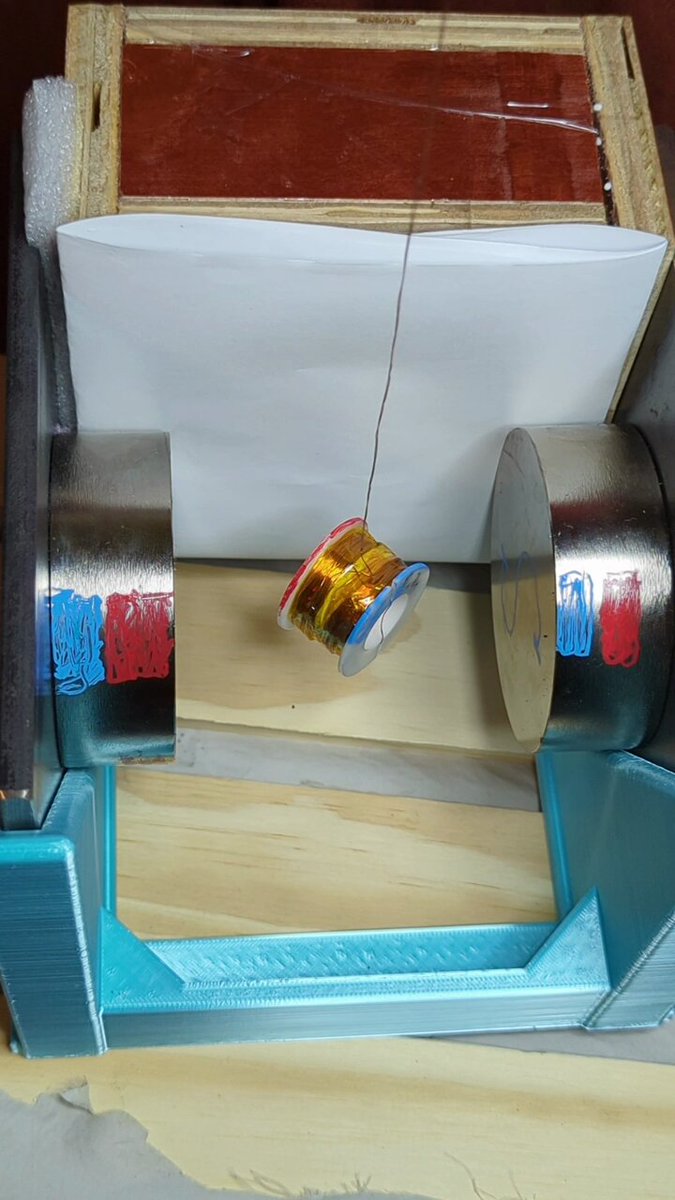
This is a simple magnetic bound-state setup based on a ⌀4 mm micromotor running at 33,000 rpm, i…

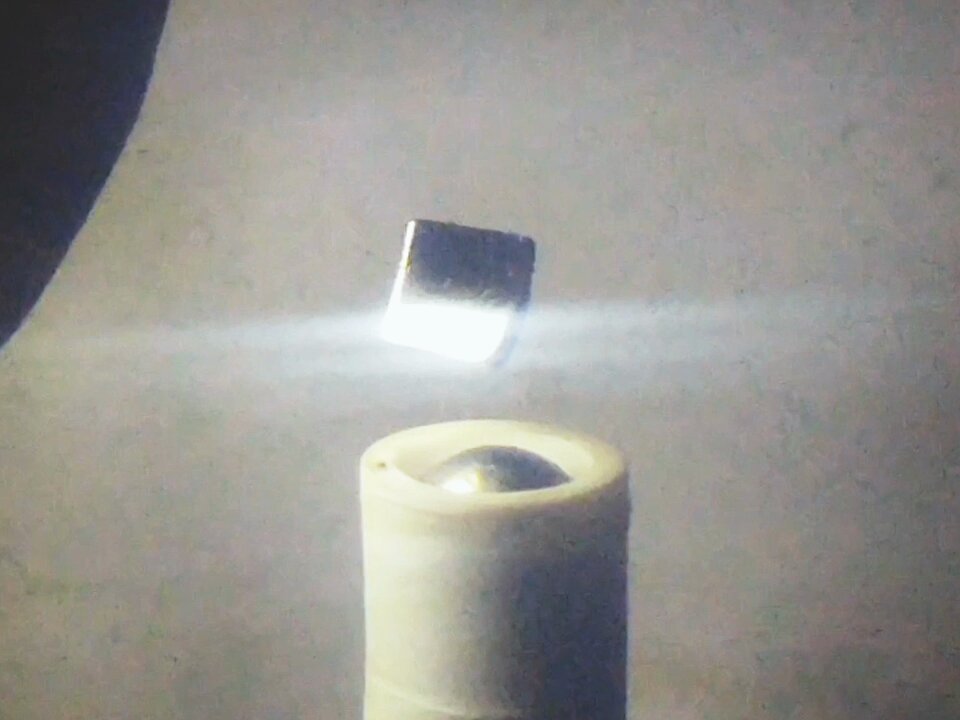
This is a simple magnetic bound-state setup based on a ⌀4 mm micromotor running at 33,000 rpm, in which a small magnet weighing ~80 mg is held horizontally in the air. In experiments so far, the smallest magnet has been ~5 mg, at a motor speed of 105K rpm.

  • magnetodynamics
Preview from Hamdi Ucar's public X post

Source-platform counters

views
21,879
likes
143
comments
6
reposts
9
Platform attention index93.9

Descriptive onlyType-relative · reach, engagement; not a measure of scientific quality or validity.

X post
Original source

Polarity Free Magnetic Repulsion and Magnetic Bound State, 9 March 2021 https://doi.org/10.3390/…

Polarity Free Magnetic Repulsion and Magnetic Bound State, 9 March 2021 https://doi.org/10.3390/sym13030442

  • magnetic bound state
  • polarity-free repulsion
Preview from Hamdi Ucar's public X post

Source-platform counters

views
3,870
likes
97
comments
0
reposts
5
Platform attention index88.7

Descriptive onlyType-relative · reach, engagement; not a measure of scientific quality or validity.

X post
Original source

Excited states in sims are not merely a mathematical curiosity. Experiments can exhibit similar …

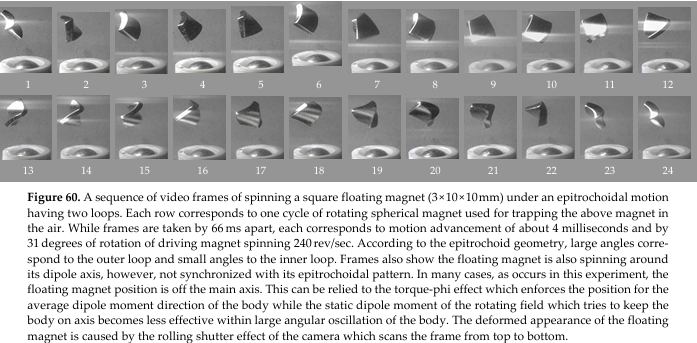
Excited states in sims are not merely a mathematical curiosity. Experiments can exhibit similar dynamics, with large-amplitude angular oscs and epitrochoidal-like trajectories. Recorded on Nov. 6, 2017. The visible distortion is a rolling-shutter artifact from the phone camera.

  • spin & angular dynamics
Preview from Hamdi Ucar's public X post

Source-platform counters

views
118,891
likes
610
comments
10
reposts
68
Platform attention index98.4

Descriptive onlyType-relative · reach, engagement; not a measure of scientific quality or validity.

X post
Original source

Corresponding polar plot (θ,ϕ) after a small phase adj. The arms are generated sequentially in t…

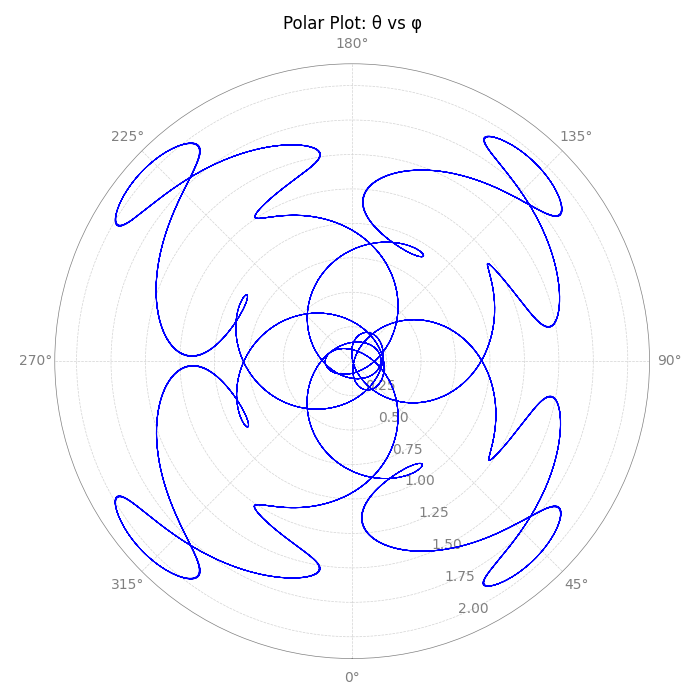
Corresponding polar plot (θ,ϕ) after a small phase adj. The arms are generated sequentially in the CW direction. Although they are not all identical, the overall pattern has vert. mirror symmetry, and the body returns to its original state after completing the full trajectory.

Preview from Hamdi Ucar's public X post

Source-platform counters

views
545
likes
6
comments
0
reposts
0
Platform attention index44.8

Descriptive onlyType-relative · reach, engagement; not a measure of scientific quality or validity.

X post
Original source

An unusual excited-state mode of MBS angular dynamics, shown in the (θ,θ˙) phase plane. The orbi…

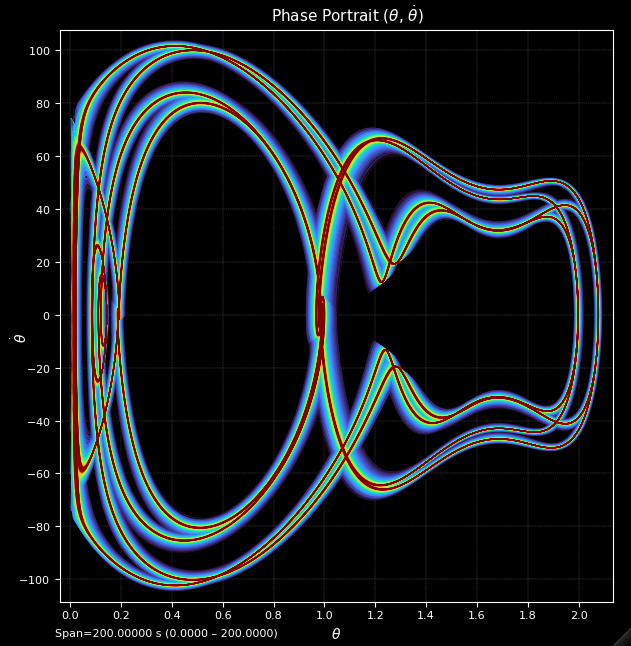
An unusual excited-state mode of MBS angular dynamics, shown in the (θ,θ˙) phase plane. The orbit exhibits two persistent branch splittings and mergers. Following a small change in mB, the curves drift slightly before stabilizing. The color gradient traces the 200-s evolution.

  • magnetic bound state
  • spin & angular dynamics
Preview from Hamdi Ucar's public X post

Source-platform counters

views
1,532
likes
21
comments
1
reposts
1
Platform attention index81.0

Descriptive onlyType-relative · reach, engagement; not a measure of scientific quality or validity.

X post
Original source

A magnetic bound-state solution by Colin McNamara (@mcnamara_colin), based on a rotating asymmet…

A magnetic bound-state solution by Colin McNamara (@mcnamara_colin), based on a rotating asymmetric quadrupole field, featuring levitation with negligible vibration. Perhaps one day the levitating figure will acknowledge the fundamental interaction keeping him aloft.

  • quadrupole & split dipole
Preview from Hamdi Ucar's public X post

Source-platform counters

views
1,391
likes
31
comments
1
reposts
2
Platform attention index80.3

Descriptive onlyType-relative · reach, engagement; not a measure of scientific quality or validity.

X post
Original source

A similar phase portrait, but here the body’s axial rotation speed varies slowly, causing the or…

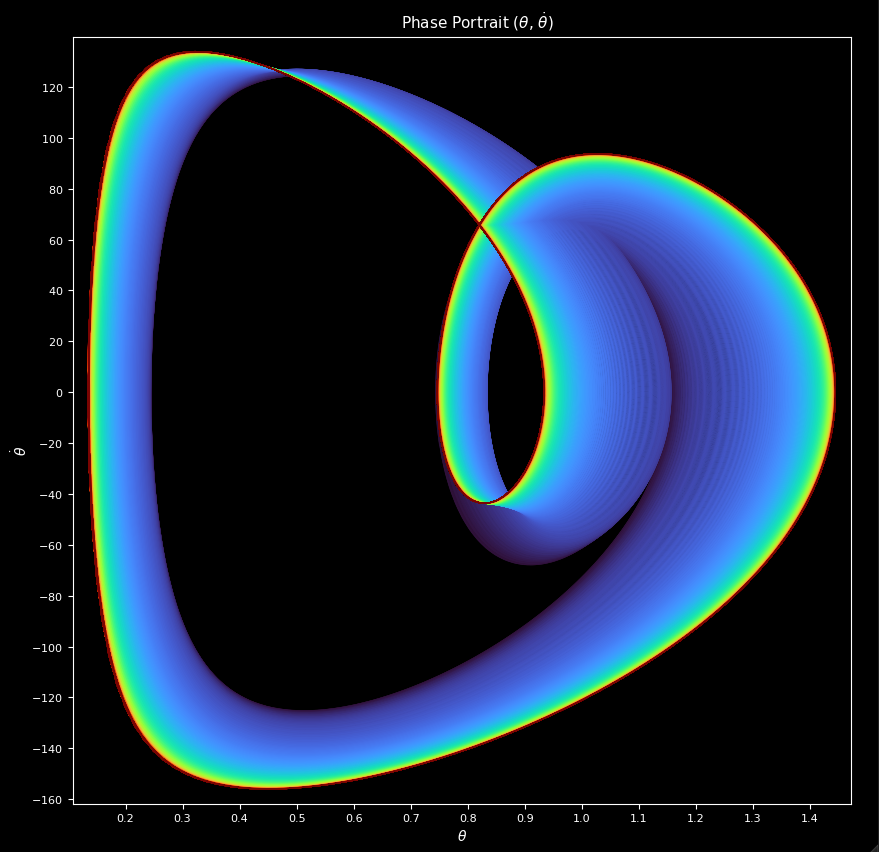
A similar phase portrait, but here the body’s axial rotation speed varies slowly, causing the orbit to evolve continuously over the 140-second simulation.

  • spin & angular dynamics
  • simulation & theory
Preview from Hamdi Ucar's public X post

Source-platform counters

views
386
likes
3
comments
0
reposts
0
Platform attention index22.3

Descriptive onlyType-relative · reach, engagement; not a measure of scientific quality or validity.

X post
Original source

Excited states offer a surprise: for the same parameters, the system supports a lower-energy, co…

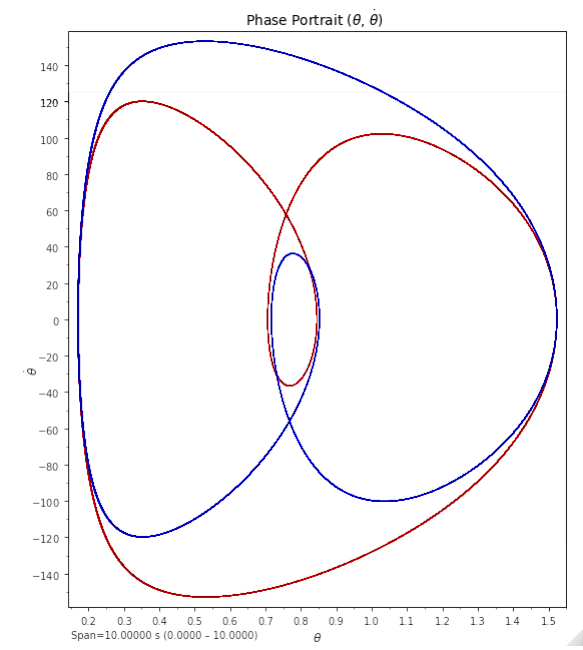
Excited states offer a surprise: for the same parameters, the system supports a lower-energy, const-θ synchronized state and two stable, conjugate high-energy periodic orbits. The second orbit is the time-reversed counterpart of the first, shown as blue/red in the phase portrait.

  • spin & angular dynamics
Preview from Hamdi Ucar's public X post

Source-platform counters

views
1,143
likes
11
comments
1
reposts
0
Platform attention index71.3

Descriptive onlyType-relative · reach, engagement; not a measure of scientific quality or validity.

X post
Original source

The simulation is generated by the Jupyter Lab application at https://github.com/HamdiUcar/mbs-a…

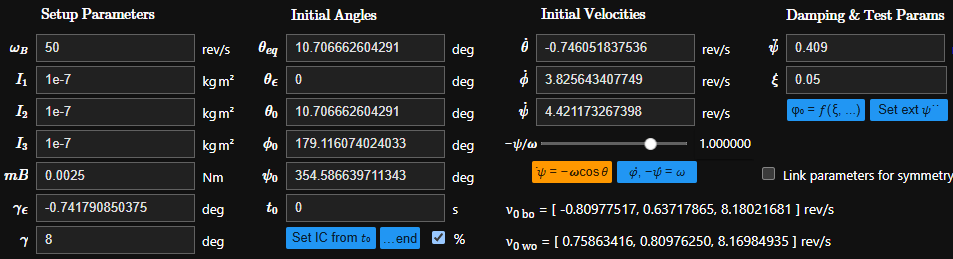
The simulation is generated by the Jupyter Lab application at https://github.com/HamdiUcar/mbs-angular-dynamics/

  • magnetic bound state
  • spin & angular dynamics
  • simulation & theory
Preview from Hamdi Ucar's public X post

Source-platform counters

views
302
likes
0
comments
0
reposts
0
Platform attention index3.5

Descriptive onlyType-relative · reach, engagement; not a measure of scientific quality or validity.

X post
Original source

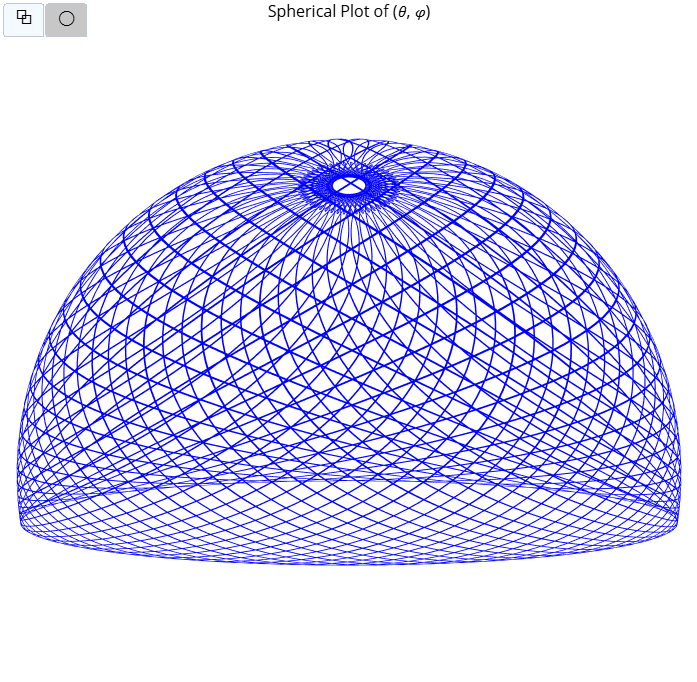
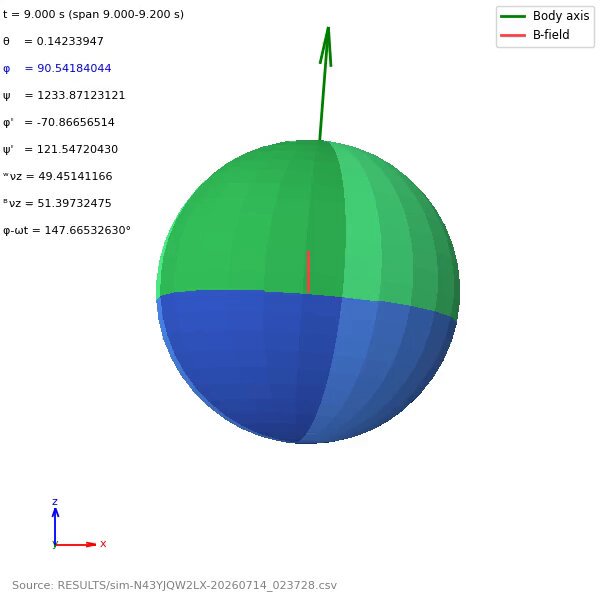
The trajectory traced by the magnetic-moment vector (shown as the green arrow in the animation) …

The trajectory traced by the magnetic-moment vector (shown as the green arrow in the animation) forms this dome-shaped pattern, covering slightly more than a hemisphere.

  • magnetodynamics
Preview from Hamdi Ucar's public X post

Source-platform counters

views
360
likes
1
comments
1
reposts
0
Platform attention index16.5

Descriptive onlyType-relative · reach, engagement; not a measure of scientific quality or validity.

X post
Original source

A simulation of the angular motion of a dipole magnet in a rotating field, showing an excited st…

A simulation of the angular motion of a dipole magnet in a rotating field, showing an excited state with large oscillations and a two-loop epitrochoid-like pattern. The same parameters with different initial conditions also allow a non-excited state.

  • spin & angular dynamics
  • oscillation & phase
  • simulation & theory
Preview from Hamdi Ucar's public X post

Source-platform counters

views
1,000
likes
13
comments
1
reposts
0
Platform attention index68.7

Descriptive onlyType-relative · reach, engagement; not a measure of scientific quality or validity.

X post
Original source

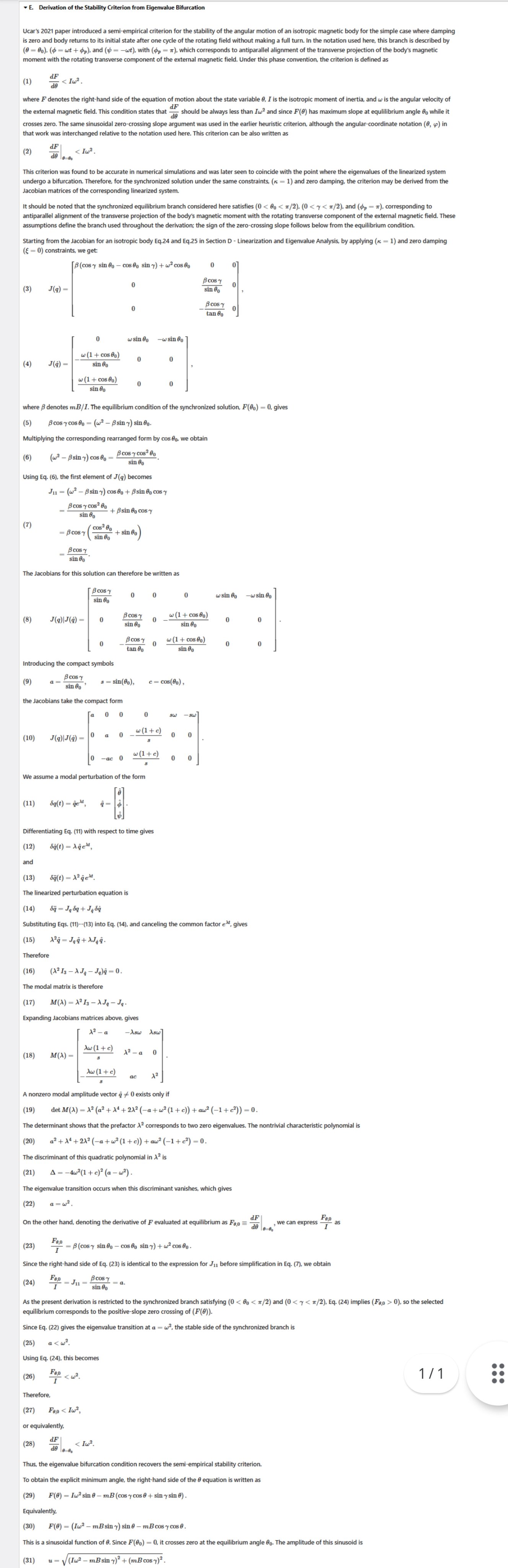
The empirical stability criterion that I introduced in 2021 can be derived as follows. Surprisin…

The empirical stability criterion that I introduced in 2021 can be derived as follows. Surprisingly, it leads to such a simple formula. +

Preview from Hamdi Ucar's public X post

Source-platform counters

views
845
likes
8
comments
1
reposts
0
Platform attention index61.6

Descriptive onlyType-relative · reach, engagement; not a measure of scientific quality or validity.

X post
Original source

I made an update on my Jupyter Lab python application / project which now includes the derivatio…

I made an update on my Jupyter Lab python application / project which now includes the derivation of my (2021) semi-empirical stability criterion from eigenvalue bifurcation. https://github.com/HamdiUcar/mbs-angular-dynamics/blob/main/derivations.pdf https://github.com/HamdiUcar/mbs-angular-dynamics

  • magnetic bound state
  • spin & angular dynamics

Source-platform counters

views
748
likes
2
comments
0
reposts
0
Platform attention index39.7

Descriptive onlyType-relative · reach, engagement; not a measure of scientific quality or validity.

X post
Original source

The rod-shaped FM is assumed to tilt into the radial plane under the centrifugal effect of its s…

The rod-shaped FM is assumed to tilt into the radial plane under the centrifugal effect of its spin. Without spin, the static components of the asymmetric quadrupole magnetic field would hold it pointing upward.

  • quadrupole & split dipole
  • spin & angular dynamics

Source-platform counters

views
289
likes
1
comments
0
reposts
0
Platform attention index2.9

Descriptive onlyType-relative · reach, engagement; not a measure of scientific quality or validity.

X post
Original source

Translational motion makes the FM center trace a small circle around the rotation axis, shifting…

Translational motion makes the FM center trace a small circle around the rotation axis, shifting the blue pole outward. The model suggests the FM is pulled the other way, but 180° phase lag displaces it like this, producing net repulsion along the z-axis.

  • polarity-free repulsion
  • oscillation & phase
  • translational locking
  • simulation & theory

Source-platform counters

views
334
likes
1
comments
1
reposts
0
Platform attention index12.6

Descriptive onlyType-relative · reach, engagement; not a measure of scientific quality or validity.

X post
Original source

This is a peculiar magnetic trapping solution realized and analyzed by D. Paschall. The setup co…

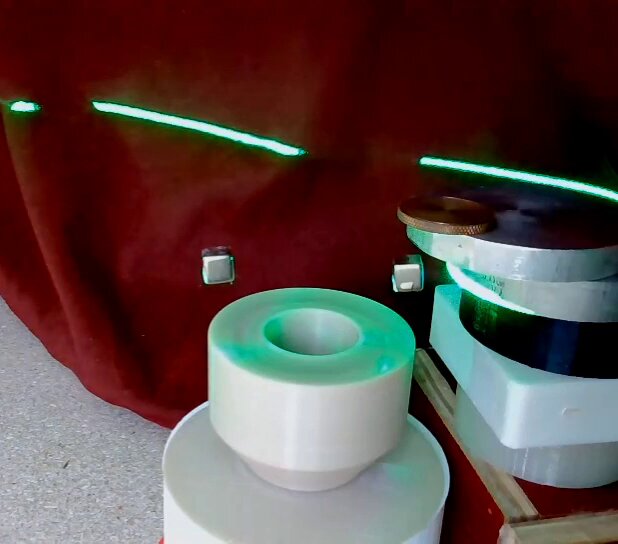
This is a peculiar magnetic trapping solution realized and analyzed by D. Paschall. The setup consists of a magnetic assembly generating an asymmetrical quadruple field and an floating assembly of 3 stacked magnets (FM) in a capsule, fully synchronized with the rotating field.

  • magnetodynamics

Source-platform counters

views
1,038
likes
1
comments
1
reposts
0
Platform attention index49.4

Descriptive onlyType-relative · reach, engagement; not a measure of scientific quality or validity.

X post
Original source

A video showing directional quantization of magnetic moment within classical physics related to …

A video showing directional quantization of magnetic moment within classical physics related to research http://dx.doi.org/10.31219/osf.io/pkusx is available. This setup and the test is made by Daniel Paschall with own resources. Full description is available at https://www.researchgate.net/publication/379958057_Bipolar_alignment_of_an_electrical_coil_with_an_static_magnetic_field

  • Kapitza & bipolar alignment
  • simulation & theory
Preview from Hamdi Ucar's public X post

Source-platform counters

views
1,380
likes
7
comments
1
reposts
1
Platform attention index71.3

Descriptive onlyType-relative · reach, engagement; not a measure of scientific quality or validity.

Blog post
Original source

Force profiles of magnetic bound state and strong nuclear force

Similarity of force profile of a magnetic bound state and the strong nuclear interaction is shown where the right figure corresponds to the force keeping nucleons together. Coefficients (a, b) are dependent on magnet configurations and chosen here for obtaining similar curves. Nuclear strong force is incredibly strong and can ke…

  • magnetic bound state
  • simulation & theory
Read preserved full copy


Similarity of force profile of a magnetic bound state and the strong nuclear interaction is shown where the right figure corresponds to the force keeping nucleons together. Coefficients (a, b) are dependent on magnet configurations and chosen here for obtaining similar curves. Nuclear strong force is incredibly strong and can keep nucleons together with a force exceeding one ton. The repusion force can be even larger and resists to a neutron star to collapse under its pressure which is calculated as 1000 MeV / fm³ ≈ 1.6 × 10³⁵ Pa.

Source-platform counters

mentions
2
Platform attention index50.0

Descriptive onlyType-relative · mentions; not a measure of scientific quality or validity.

X post
Original source

An impressive magnetic trapping setup from Daniel Paschall based on rotating quadrupole field in…

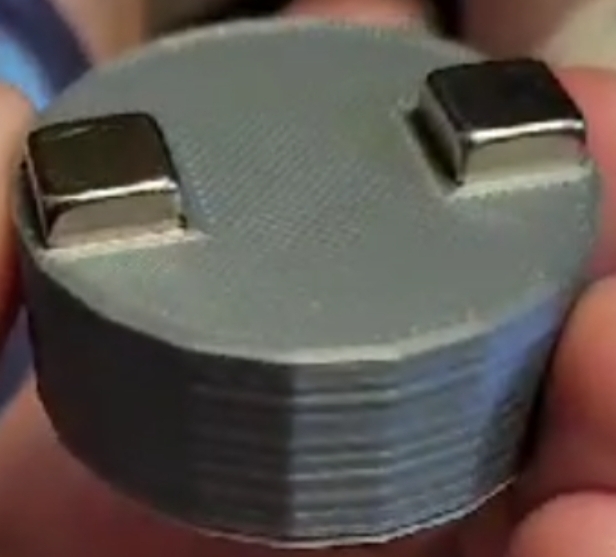
An impressive magnetic trapping setup from Daniel Paschall based on rotating quadrupole field in an arrangement that we call "split dipole". This time these dipoles magnets (3/8" cubes) are placed in 20° angle with the radial plane and separated by 3/4".

  • quadrupole & split dipole
Preview from Hamdi Ucar's public X post

Source-platform counters

views
565
likes
6
comments
0
reposts
0
Platform attention index46.8

Descriptive onlyType-relative · reach, engagement; not a measure of scientific quality or validity.

Blog post
Original source

New magnetic trapping solutions from Daniel Paschall and from Colin McNamara

An impressive magnetic trapping setup from Daniel Paschall based on rotating quadrupole field in an arrangement that we call "split dipole". This time these dipoles magnets (3/8" cubes) are placed in 20° angle with the radial plane and separated by 3/4". pic.twitter.com/6CX8yH3ZLz — Sudanamaru (H. Ucar) (@Sudanamaru1) September…

  • quadrupole & split dipole
  • translational locking
Read preserved full copy

An impressive magnetic trapping setup from Daniel Paschall based on rotating quadrupole field in an arrangement that we call "split dipole". This time these dipoles magnets (3/8" cubes) are placed in 20° angle with the radial plane and separated by 3/4". pic.twitter.com/6CX8yH3ZLz

— Sudanamaru (H. Ucar) (@Sudanamaru1) September 16, 2023

This image shows the same setup but without the cover of the matchbox. The ivibration makes the blurred appearance. pic.twitter.com/AfV0W85OXE

— Sudanamaru (H. Ucar) (@Sudanamaru1) September 6, 2023

torque present in other schemes. pic.twitter.com/P0qzxv7rYD

— Sudanamaru (H. Ucar) (@Sudanamaru1) August 26, 2023

A very friendly setup from Colin McNamara. The drum consists of two cube magnets, poles oriented radially and attracting each other that we call split dipole scheme. This arrangement generates quadrupole zones allowing magnets to be trapped at its magnetically quietest location. pic.twitter.com/71ZtEiFbon

— Sudanamaru (H. Ucar) (@Sudanamaru1) August 25, 2023

A beautiful realization of a magnetic trapping solution using rotating magnetic fields made by D. Paschall. Science is inspiring! pic.twitter.com/T9MvuTWFWy

— Sudanamaru (H. Ucar) (@Sudanamaru1) August 4, 2023

Source-platform counters

views
2,820
likes
29
comments
2
reposts
0
mentions
13
Platform attention index33.2

Descriptive onlyType-relative · reach, engagement, mentions; not a measure of scientific quality or validity.

Blog post
Original source

Twitter mirror pages

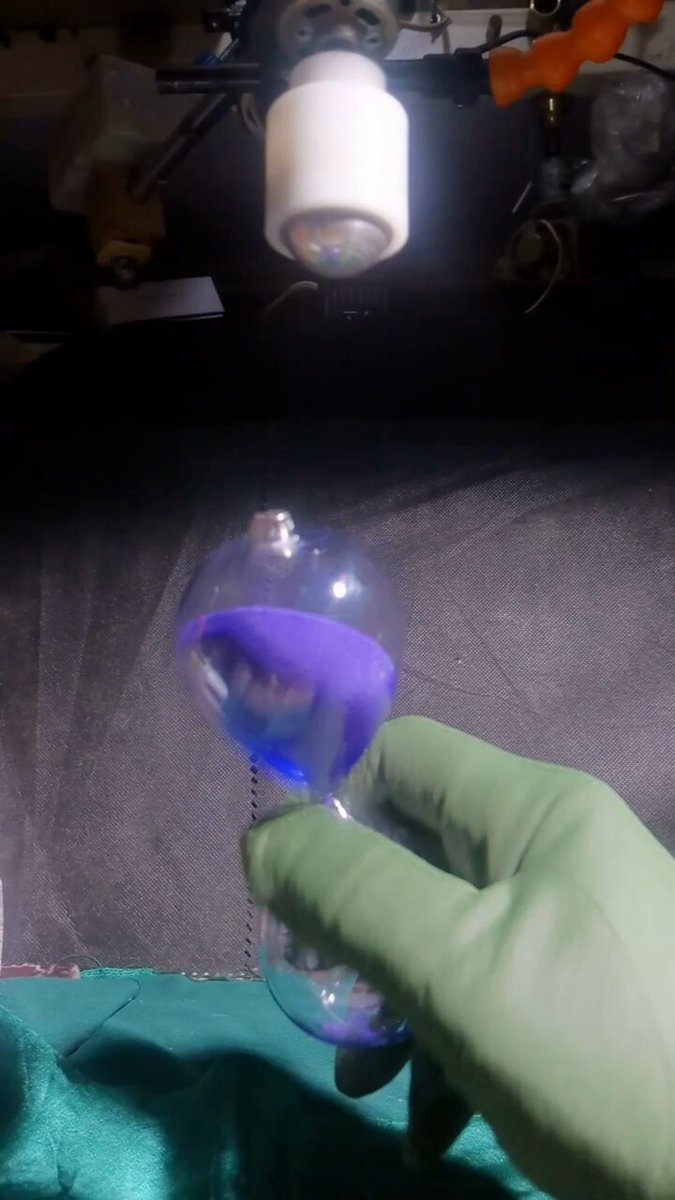
Doesn't look like a classified experiment from 90's? pic.twitter.com/6GuTjvHgUS — Sudanamaru (H. Ucar) (@Sudanamaru1) August 19, 2023 Watching an hourglass can be boring, and even it floats in air! Dated August 10, 2022 pic.twitter.com/mA3MhFqsee — Sudanamaru (H. Ucar) (@Sudanamaru1) August 19, 2023 This video gives a stroboscop…

  • magnetic bound state
  • spin & angular dynamics
  • translational locking
Read preserved full copy

Doesn't look like a classified experiment from 90's? pic.twitter.com/6GuTjvHgUS

— Sudanamaru (H. Ucar) (@Sudanamaru1) August 19, 2023

Watching an hourglass can be boring, and even it floats in air! Dated August 10, 2022pic.twitter.com/mA3MhFqsee

— Sudanamaru (H. Ucar) (@Sudanamaru1) August 19, 2023

This video gives a stroboscopic view of a magnetic bound state dynamics. Actually it is a standard video recording while the shuttle speed set high due to intense illumination of the scene. Stroboscopic view is obtained by adjusting speed of the motor close to 60 rev/sec. pic.twitter.com/bWenGsurQA

— Sudanamaru (H. Ucar) (@Sudanamaru1) January 27, 2023

Source-platform counters

views
12,333
likes
137
comments
11
reposts
16
mentions
7
Platform attention index76.2

Descriptive onlyType-relative · reach, engagement, mentions; not a measure of scientific quality or validity.

X post
Original source

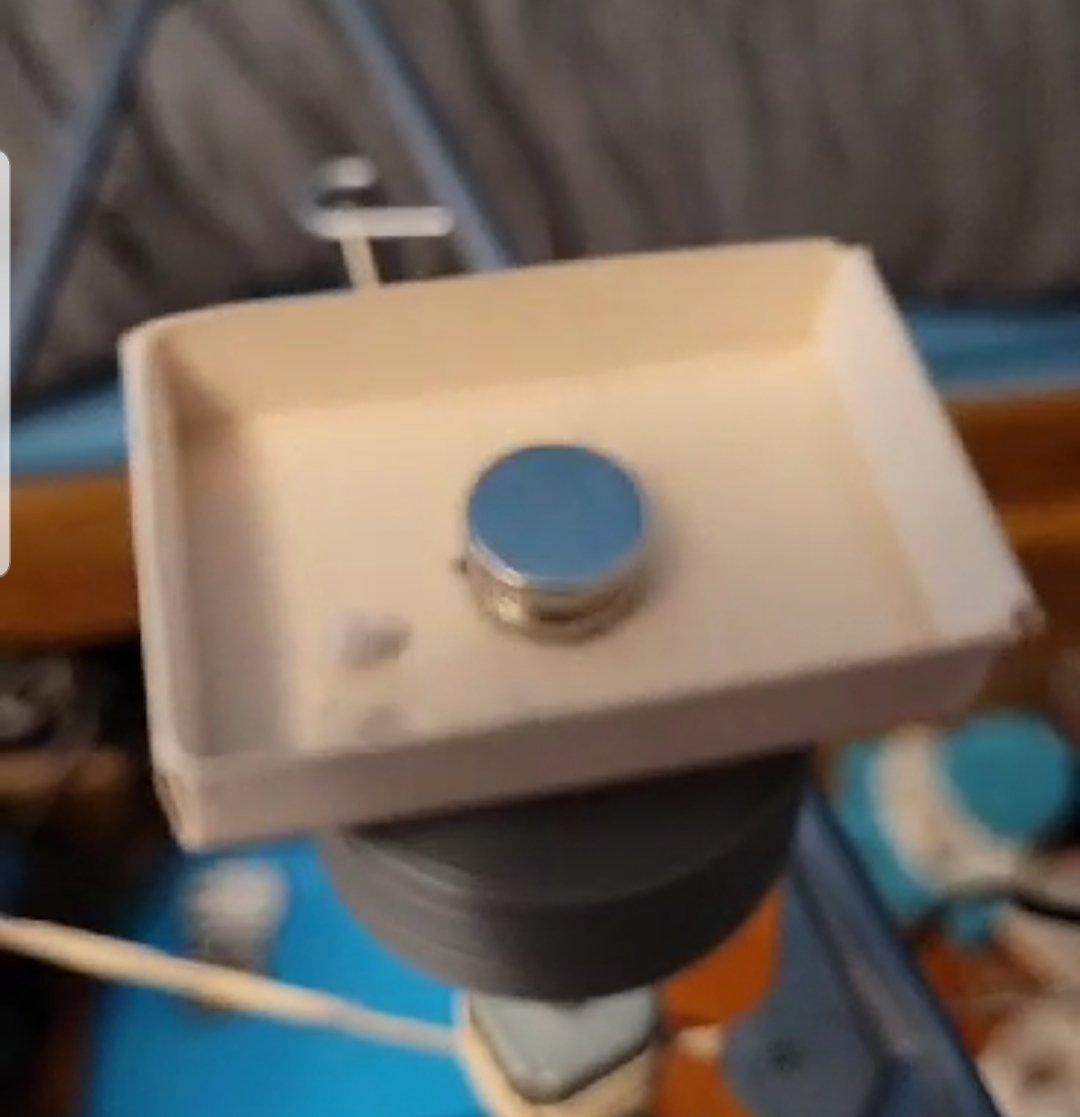
This image shows the same setup but without the cover of the matchbox. The ivibration makes the …

This image shows the same setup but without the cover of the matchbox. The ivibration makes the blurred appearance.

  • translational locking
Preview from Hamdi Ucar's public X post

Source-platform counters

views
370
likes
2
comments
0
reposts
0
Platform attention index14.5

Descriptive onlyType-relative · reach, engagement; not a measure of scientific quality or validity.

X post
Original source

A floating matchbox having a centered magnet inside using a rotating magnetic field realized by …

A floating matchbox having a centered magnet inside using a rotating magnetic field realized by Colin McNamara. The motor driven magnetic assembly consists of two 3/8" cube magnets in parallel and separated with a gap in a radial orientation.

  • translational locking
Preview from Hamdi Ucar's public X post

Source-platform counters

views
511
likes
4
comments
1
reposts
0
Platform attention index41.0

Descriptive onlyType-relative · reach, engagement; not a measure of scientific quality or validity.

X post
Original source

torque present in other schemes.

torque present in other schemes.

Preview from Hamdi Ucar's public X post

Source-platform counters

views
423
likes
4
comments
1
reposts
0
Platform attention index31.3

Descriptive onlyType-relative · reach, engagement; not a measure of scientific quality or validity.

X post
Original source

A very friendly setup from Colin McNamara. The drum consists of two cube magnets, poles oriented…

A very friendly setup from Colin McNamara. The drum consists of two cube magnets, poles oriented radially and attracting each other that we call split dipole scheme. This arrangement generates quadrupole zones allowing magnets to be trapped at its magnetically quietest location.

  • quadrupole & split dipole
Preview from Hamdi Ucar's public X post

Source-platform counters

views
505
likes
7
comments
0
reposts
0
Platform attention index42.9

Descriptive onlyType-relative · reach, engagement; not a measure of scientific quality or validity.

X post
Original source

Doesn't look like a classified experiment from 90's?

Doesn't look like a classified experiment from 90's?

Preview from Hamdi Ucar's public X post

Source-platform counters

views
620
likes
6
comments
0
reposts
1
Platform attention index54.5

Descriptive onlyType-relative · reach, engagement; not a measure of scientific quality or validity.

X post
Original source

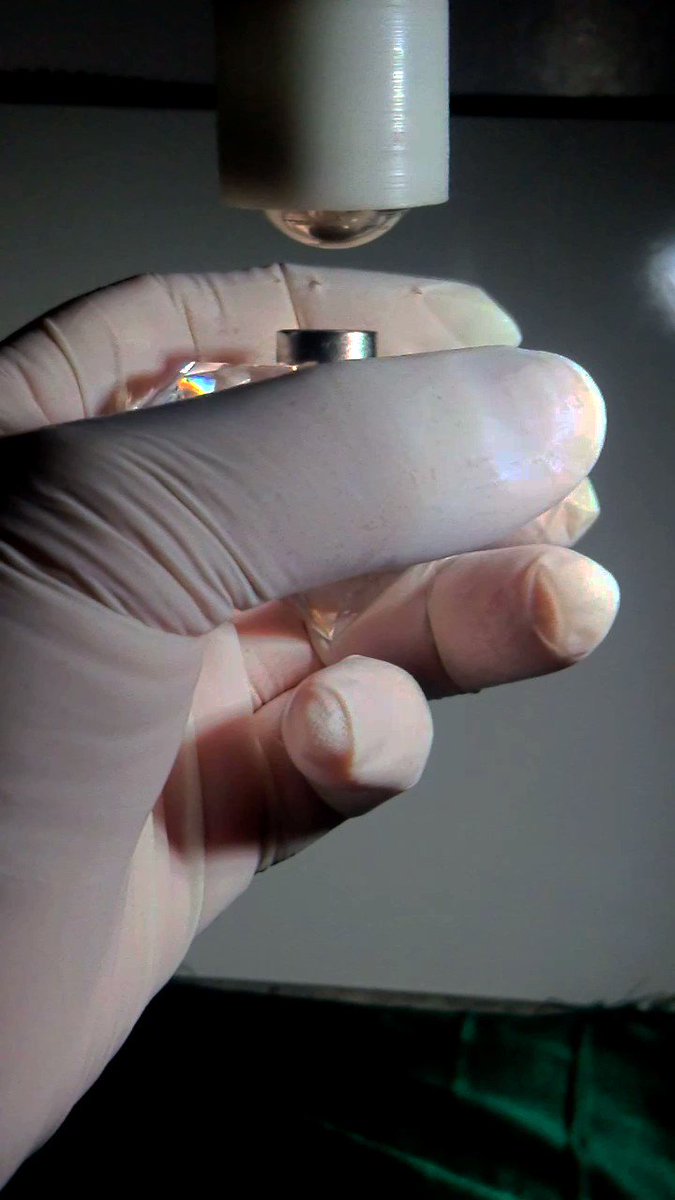
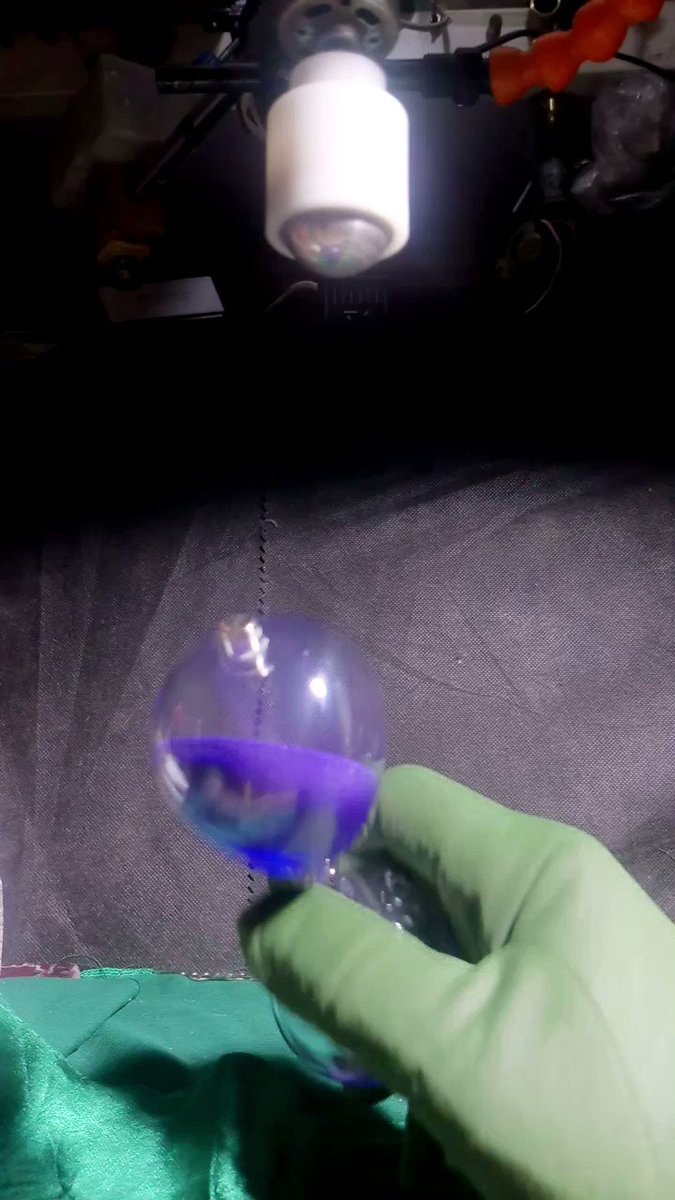
Watching an hourglass can be boring, and this one might be too! Dated August 10, 2022

Watching an hourglass can be boring, and this one might be too! Dated August 10, 2022

  • translational locking
Preview from Hamdi Ucar's public X post

Source-platform counters

views
461
likes
4
comments
0
reposts
0
Platform attention index33.2

Descriptive onlyType-relative · reach, engagement; not a measure of scientific quality or validity.

X post
Original source

A beautiful realization of a magnetic trapping solution using rotating magnetic fields made by D…

A beautiful realization of a magnetic trapping solution using rotating magnetic fields made by D. Paschall. Science is inspiring!

  • magnetodynamics
Preview from Hamdi Ucar's public X post

Source-platform counters

views
446
likes
6
comments
0
reposts
0
Platform attention index35.2

Descriptive onlyType-relative · reach, engagement; not a measure of scientific quality or validity.

X post
Original source

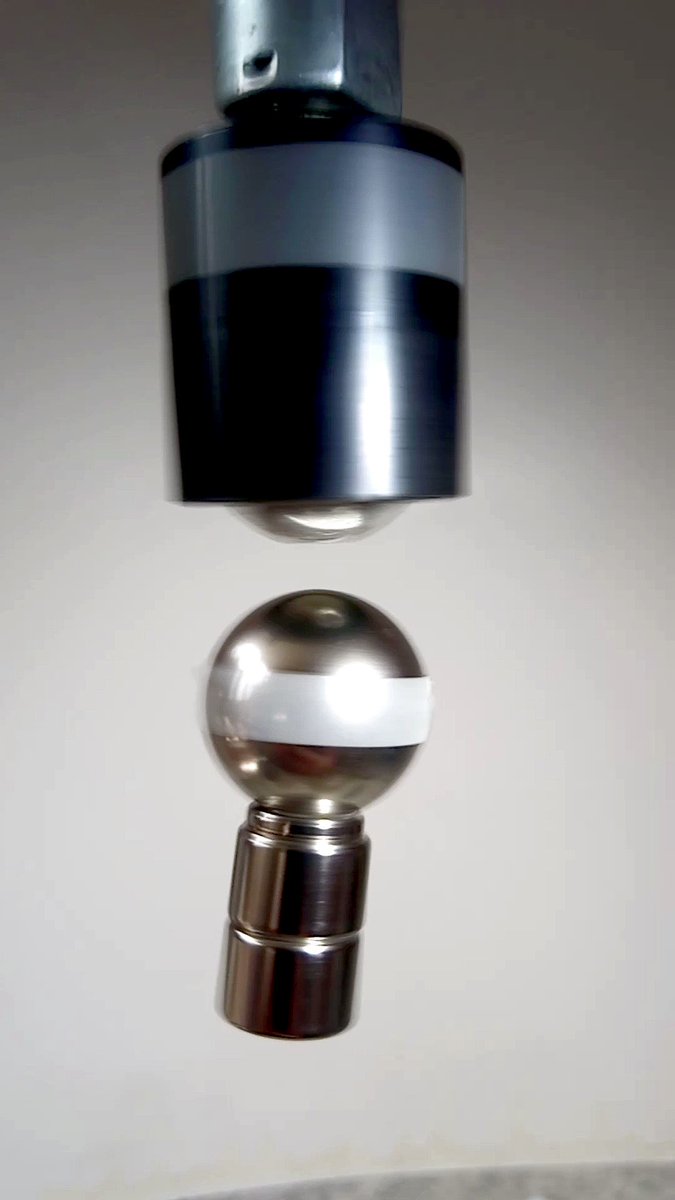
This magnetic bound state solution works like a contactless spherical joint. The floating assemb…

This magnetic bound state solution works like a contactless spherical joint. The floating assembly is spinning at 4000 RPM, exactly at half speed of the driving field. It is a stack of a ⌀25.4 mm sphere (N42), two ⌀15×10 mm (N35) and a small ring magnet. Dated June 16, 2022.

  • magnetic bound state
  • spin & angular dynamics
Preview from Hamdi Ucar's public X post

Source-platform counters

views
425
likes
5
comments
2
reposts
0
Platform attention index41.0

Descriptive onlyType-relative · reach, engagement; not a measure of scientific quality or validity.

Blog post
Original source

A short note about directional quantization of oscillatory magnetic dipole moments associated with moments of inertia

This note points out the possibility of fast oscillations within magnetic moments of quantum particles in the light of a recent finding (1 ) . Kapitza pendulum (inverted pendulum) is a pendulum where its pivot is forced to vibrate up and down and this allows the pendulum to stay upright against gravity which is not possible with…

  • Kapitza & bipolar alignment
  • oscillation & phase
  • simulation & theory
Read preserved full copy
This note points out the possibility of fast oscillations within magnetic moments of quantum particles in the light of a recent finding (1).

Kapitza pendulum (inverted pendulum) is a pendulum where its pivot is forced to vibrate up and down and this allows the pendulum to stay upright against gravity which is not possible with a regular pendulum. It was discovered in 1908 but only explained in 1951 (2) and later by Landau (3) through the effective potential model. It is also known that Kapitza pendulum can be realized magnetically by the work of Lisovskii et al., 2007 (4) by subjecting a compass needle to the field of a Helmholtz coil driven by an AC signal.


The same behaviour can be obtained with a magnetic body having an oscillatory magnetic moment with an asymmetry, for example an electromagnet driven by AC signal and also having a small DC bias (1). Exposing such a body to a static magnetic field causes to vibrate it and as a result, this body can find stable equilibrium against the magnetic field (anti-parallel) with respect to it's time-averaged magnetic moment and also can be aligned with it in parallel as an ordinary magnet can do. This means an oscillatory magnetic dipole moment associated with a moment of inertia can find two stable orientations with respect to the static magnetic field it is subjected to.


This is similar to the result of the Stern-Gerlach experiment made in 1922 (5) which confirmed the hypothesis of directional quantization (6) (Richtungsquantelung) and showed silver atoms sent with random orientation exit the apparatus with polarizations either in parallel or antiparallel orientations with respect to a magnetic field it traverses. This result caused serious difficulties within classical physics and shaped the emerging quantum mechanics. Now, a hundred years later, the Kapitza pendulum gives the opportunity to reinterpret the Stern-Gerlach experiment with the idea of inbuilt fast oscillations of magnetic moments.


[1] Ucar, H. Directional quantization of an oscillatory magnetic dipole moment associated with a moment of inertia, 2023. https://doi.org/10.31219/osf.io/pkusx


[2] P. L. Kapitza. Pendulum with a vibrating suspension. Usp. Fiz. Nauk, 44:7–15, 1951.


[3] L.D. Landau and E.M. Lifshitz, Mechanics (Pergamon, Oxford, 1960), pp. 93-95. https://doi.org/10.1002/zamm.19610410910


[4] Lisovskii, F.V., Mansvetova, E.G. Analogue of the Kapitza pendulum based on a compass arrow in an oscillating magnetic field. Bull. Russ. Acad. Sci. Phys. 71, 1500–1502 (2007). https://doi.org/10.3103/S1062873807110044

[5] Gerlach, W., Stern, O. Das magnetische Moment des Silberatoms. Z. Physik 9, 353–355 (1922). https://doi.org/10.1007/BF01326984


[6] Schmidt-Böcking, H., Schmidt, L., Lüdde, H.J. et al. The Stern-Gerlach experiment revisited. EPJ H 41,327–364 (2016). https://doi.org/10.1140/epjh/e2016-70053-2


Source-platform counters

mentions
4
Platform attention index65.0

Descriptive onlyType-relative · mentions; not a measure of scientific quality or validity.

Blog post
Original source

I wrote a note about stability of magnetic bound state which evaluate the stability partially based

I wrote a note about stability of magnetic bound state which evaluate the stability partially based on the zenithal angle of the free body. Preprint: https://doi.org/10.31219/osf.io/uymc2 A note on the stability of the angular motion of a free body with a magnetic moment exposed to a rotating magnetic field Hamdi Ucar jxucar@gma…

  • magnetic bound state
  • spin & angular dynamics
  • simulation & theory
Read preserved full copy

 I wrote a note about stability of magnetic bound state which evaluate the stability partially based on the zenithal angle of the free body. 

Preprint:  https://doi.org/10.31219/osf.io/uymc2


A note on the stability of the angular motion of a free body with a magnetic moment exposed to a rotating magnetic field


Hamdi Ucar

jxucar@gmail.com


June 29, 2023


A basic magnetic bound state solution in classical physics requires the free body to perform a distinct cyclic angular motion as a result of its interaction with a rotating magnetic field. This motion resembles that of the arm of a spherical pendulum, tracing a conical pattern. The orientation of the pendulum arm corresponds to the orientation of the free body which is identified by its magnetic moment vector. According to the model in a basic configuration, this vector rotates synchronously with the rotating field on the same axis and maintains a constant zenithal angle, referred to as φ. While this angle satisfies the equilibrium between the magnetic torque exerted on the body and its inertial response, the stability analysis of this equilibrium with respect to the angle φ has not been fully explored mathematically. The complete analytical evaluation of the motion's stability can be challenging due to the non-linear nature of the equations of motion. However, we can examine a fundamental stability requirement to determine if the equilibrium might be stable. If this requirement is not met, the equilibrium is inherently unstable; otherwise, it may exhibit stability depending on the specific conditions provided. Through the evaluation of magnetic torque and angular displacement vectors it is found the dynamics satisfy a basic stability requirement.


Source-platform counters

mentions
0
Platform attention index10.0

Descriptive onlyType-relative · mentions; not a measure of scientific quality or validity.

Publication
Original source

A note on the stability of the angular motion of a free body with a magnetic moment exposed to a rotating magnetic field

A stability note on a freely moving magnetic body in a rotating magnetic field, including angular modes, phase relationships, and large-amplitude motion.

  • spin & angular dynamics

Source-platform counters

views
209
citations
0
downloads
192
mentions
0
Platform attention index19.8

Descriptive onlyType-relative · reach, citations, downloads, mentions; not a measure of scientific quality or validity.

Publication
Original source

Directional quantization of an oscillatory magnetic dipole moment associated with a moment of inertia

A note exploring parallel and antiparallel stable alignments of an oscillatory magnetic dipole moment in an external static magnetic field.

  • Kapitza & bipolar alignment
  • oscillation & phase
  • simulation & theory

Source-platform counters

views
354
citations
0
downloads
1,020
mentions
1
Platform attention index51.0

Descriptive onlyType-relative · reach, citations, downloads, mentions; not a measure of scientific quality or validity.

Blog post
Original source

Phase characteristics of driven harmonic motion is explained in plain text

This assay aims to explain the phase characteristics of driven harmonic motion using an example without relying on equations. Although the mathematical explanation of the phase relation in this motion is straightforward, an intuitive understanding might be achieved through relatable everyday experiences. This is the property whe…

  • oscillation & phase
  • simulation & theory
Read preserved full copy

This assay aims to explain the phase characteristics of driven harmonic motion using an example without relying on equations. Although the mathematical explanation of the phase relation in this motion is straightforward, an intuitive understanding might be achieved through relatable everyday experiences.


This is the property where the phase of the driven subject can be in the same phase of the driving mechanism when the driving frequency is below the natural frequency of the system and can be in the opposite phase otherwise. Here we assume the system is frictionless, otherwise these phase figures can deviate depending on the friction amount and on the ratio of frequencies.

To illustrate this, let's consider a classical piston-spring-mass system. In this setup, a mass is connected to a piston via a weightless spring, allowing the mass to move back and forth along a single axis, denoted as the x-axis.

We know that a spring-mass system as a simple harmonic oscillator, it can oscillate at a specific frequency called natural frequency when the mass is released from a non-equilibrium position, such as when the spring is stretched or compressed. The oscillation frequency can be changed by using different lengths of the spring. For instance, if we attach one end of the spring to a non-moving base and connect the mass to the other end, the oscillation frequency will be lower compared to using a shorter length of the spring.

In a driven harmonic motion scenario, we have a mass attached to a spring while the other end of spring is attached to a mechanism called the piston that can cyclically move back and forth along the length of the spring. In this system, the mass may exhibit a combined motion carrying both the natural frequency of the spring-mass system and the frequency of the piston. However, we can initiate the system in such a way that the mass oscillates solely at the frequency of the piston's motion. Let assume this is obtained by initially introducing a damping factor that decays the natural frequency components and subsequently progressively reducing and removing the damping factor.

Now, let's proceed with the experiment: Assuming we can run the piston at various speeds, performing a smooth sinusoidal motion, we can set a speed at which we observe the piston and the mass moving in opposite directions all the time. In other words, during one-half of a cycle, the piston and the mass approach each other, while during the other half, they move away from each other.

Under these conditions, we expect to observe a stationary point along the spring. Since the system is assumed to have negligible or a small friction, we can expect that the system will continue oscillating in this manner for a while even if we physically fix the spring to a base at this stationary point. By doing so, the spring-mass part of the system effectively becomes a simple harmonic oscillator and oscillates at a frequency determined by this part of the spring, which is higher than the natural frequency of the full-length (spring) system. The crucial point here is that this higher natural frequency (of the mass-spring system beginning from the stationary point) corresponds to the actual frequency of the piston's motion. This leads us to the following conclusion:

If we observe a stationary point in a driven harmonic oscillator based on a piston-spring-mass system, or if we consistently notice the ends of the spring moving in opposite directions, we can infer that the piston is operating at a frequency higher than the natural frequency of the system.

It can be also said: If one forces to oscillate a spring-mass system above its natural frequency by driving it from other end of the spring, the result is that the ends of the spring move always in opposite directions.

Note that if the system has some friction (damping), there would be no truely stationary point along the spring however, it would be not hard to spot the point along the spring where the motion is minimum.

A complete evaluation of the driven harmonic motion/oscillator can be found at http://farside.ph.utexas.edu/teaching/315/Waves/node13.html


Source-platform counters

mentions
2
Platform attention index50.0

Descriptive onlyType-relative · mentions; not a measure of scientific quality or validity.

Blog post
Original source

Magnetic bound state of magnets are explained by slow motion visuals

This video gives a stroboscopic view of a magnetic bound state dynamics. Actually it is a standard video recording while the shuttle speed set high due to intense illumination of the scene. Stroboscopic view is obtained by adjusting speed of the motor close to 60 rev/sec. In the below video from a similar setup t he syncronized…

  • magnetic bound state
  • polarity-free repulsion
  • spin & angular dynamics
  • oscillation & phase
  • translational locking
Read preserved full copy

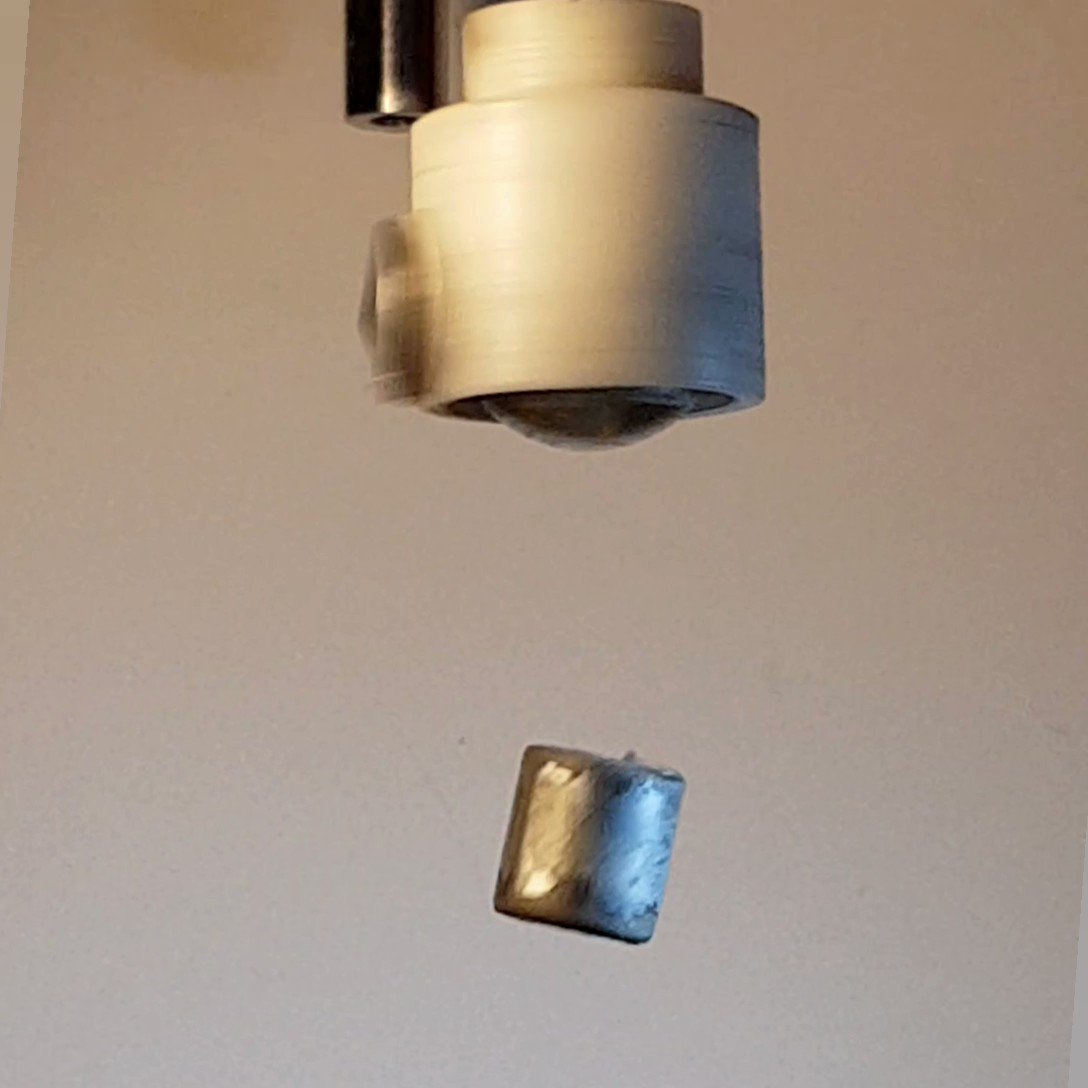
This video gives a stroboscopic view of a magnetic bound state dynamics. Actually it is a standard video recording while the shuttle speed set high due to intense illumination of the scene. Stroboscopic view is obtained by adjusting speed of the motor close to 60 rev/sec.

Open the embedded video at the original post ↗


In the below video from a similar setup the syncronized angular motion of the floating magnet with the driving magnet can be clearly seen. In this motion the top pole (S) of the floating magnet leans toward the S pole of the driving magnet all the time despite it get repelled.

Open the embedded video at the original post ↗


This figure below shows an instance from the above video where poles of magnets are marked with letters in white. We can see that the top magnet is not aligned by 90 degrees to the shaft but tilted about 10 degrees. This alignment can be thought as superposition of two virtual magnets, one orthogonal to the shaft (radial) and the other (axial, blue) aligned with the shaft. The virtual radial magnet has strength of the real magnet by the cosine of the tilt angle and the axial one by the sine.
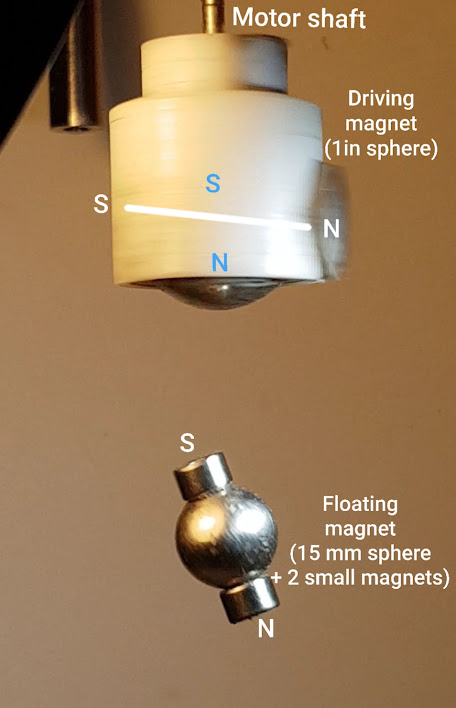


Time average of the radial magnet vanishes but the axial (blue) one resides. So there is a good reason for another magnet nearby to get aligned to the blue virtual magnet and get attracted. This is the case of the floating magnet beneath, however it does not stay fully aligned since it oscillates.


The cause of this oscillation is the rotation of the top magnet, precisely the virtual radial magnet. This magnet exerts continually spatially varying torque to the floating magnet causing a driven harmonic motion. This rotates the magnet orientation and can be called conical motion. In this picture instance the torque vector is perpendicular to the page and trying to rotate the floating magnet clockwise.


This motion can be fully synchronized with the top magnet under suitable conditions. This is the case in this video where the orientation of these magnets are locked to each other. That is looking through a camera  which co-rotates with the driving magnet, all magnetic orientations, fields, torques, forces are standing still. Only the floating magnet can spin around its dipole axis freely. What is quite interesting here is the polar alignments of magnets.


We are seeing that the S pole of the bottom magnet leans toward the S pole of the top magnet despite it getting repelled. This appears counterintuitive however it is the result of the driven harmonic motion (DHM) and called phase lag.


In DHM, the displacement and the driving force can be in the same or in the opposite direction depending on the frequency of the driving force. Every harmonic motion can be associated with a natural frequency. This frequency is determined by the inertial factor of the object under harmonic motion and the spring constant of the force applied to this object. Inertial factor is the moment of inertia and we use spring constant related to torque and angular displacement here.


Using the spring constant term C and a mass m, the natural frequency ω₀ can be calculated by the relation ω₀² = C/m. Although the spring constant term can only be applied here by approximation, we only need to estimate the natural frequency here as an order of magnitude.


Phase lag is the phase of the motion with respect to the driving force or torque. If we neglect frictions or other causes of damping in a DHM, phase lag is zero when driving frequency is below than natural frequency and becomes 180° when it is above. Here the motor speed is likely well above the natural frequency and the phase lag is 180°. For this reason the S pole of the floating magnet is looking at the S pole of the top magnet all the time. 


The net effect is the phrase lag which keeps the floating magnet orientation stable with respect to the rotating magnet favoring repulsion. Such an orientation is impossible to obtain between static magnets when one magnet is free to move. 

In summary the tilt of the rotating magnet causes an attraction to the floating magnet which is balanced by the weight of the magnet and by the magnetic repulsion explained here. We can call this equilibrium as a magnetic bound state.


This equilibrium is stable because the repulsion factor increases two times faster than the attraction when magnets get closer. This is because the amplitude of angular motion increases when magnets get closer resulting in a larger conical motion. 


Actually the strength of the repulsion is approximately proportional to the amplitude of this oscillation. For this reason, increasing the motor speed (the frequency) reduces oscillation amplitude, causing the repulsion factor to reduce. This way floating magnet can approach the driving magnet more and can find a new equilibrium where attractive and repulsive interactions become stronger than before. This reduced air gap allows the interaction to carry more loads.


In detail, the dependence of the oscillation amplitude on the frequency is approximately inverse square when this frequency is significantly larger than the natural frequency of the system. The related equation can also be found in common texts on driven harmonic motion. Only we deal here with angular oscillation, torque and moment of inertia instead of translational motion, force and mass. It should be noted natural frequency term ω₀  is mostly used in textbooks in related equations. This property can be easily identified and observed in textbook examples however not in these magnetic trapping solutions.
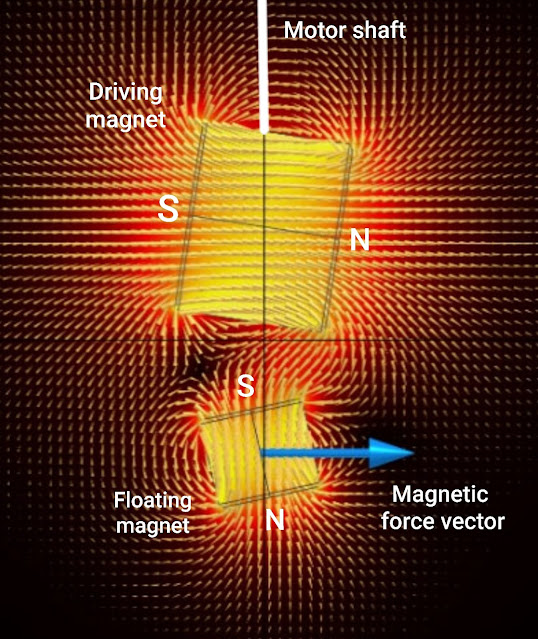


This image shows the magnetic field of a similar setup. The magnetic force vector is horizontal and it rotates around the vertical axis (motor shaft direction) This means its time average is zero. This rotating force causes the FM to perform small circles with a sub mm radius. This circular motion has also characteristics of the DHM. That is the displacement of the body can be in the opposite direction of the force it receives and bring repelling poles of magnets even closer.


[image]

We also see that large floating magnets or magnets fixed to rigid loads oscillate less. This is because oscillation amplitude is also dependent inversely to the moment of inertia of the floating object with respect to its pivoting center. This pivoting center can be different from the dipole center and the center of mass when floating bodies consist of a magnet attached to an inert mass.

Source-platform counters

mentions
6
Platform attention index75.0

Descriptive onlyType-relative · mentions; not a measure of scientific quality or validity.

X post
Original source

This video gives a stroboscopic view of a magnetic bound state dynamics. Actually it is a standa…

This video gives a stroboscopic view of a magnetic bound state dynamics. Actually it is a standard video recording while the shuttle speed set high due to intense illumination of the scene. Stroboscopic view is obtained by adjusting speed of the motor close to 60 rev/sec.

  • magnetic bound state
  • spin & angular dynamics
Preview from Hamdi Ucar's public X post

Source-platform counters

views
11,252
likes
127
comments
11
reposts
15
Platform attention index93.2

Descriptive onlyType-relative · reach, engagement; not a measure of scientific quality or validity.

Blog post
Original source

Another summary of the magnetic bound state (in classical mechanics)

Below is the comment I wrote on Reddit some times ago ( https://www.reddit.com/r/physicsmemes/comments/w0njlh/gluons_in_action/ ) about one my experiment video titled "Gluons" in action which showing a realization of a magnetic bound state solution. It summarizes the effect and explains how it works: This video shows a bound sta…

  • magnetic bound state
  • polarity-free repulsion
  • spin & angular dynamics
  • oscillation & phase
  • simulation & theory
Read preserved full copy

Below is the comment I wrote on Reddit some times ago (https://www.reddit.com/r/physicsmemes/comments/w0njlh/gluons_in_action/) about one my experiment video titled "Gluons" in action  which showing a realization of a magnetic bound state solution. It summarizes the effect and explains how it works:

This video shows a bound state between two dipole magnetic bodies as ordinary neodymium magnets.

As a background theory, two magnets or anything can not be contactless bound statically by force fields alone, say gravitational, electrostatic or magnetic or their any combinations as stated by the Earnshaw theorem. However this can be achived when inertial forces are involved. In this case, we have also inertial forces and torques, therefore requires acceleraration and motion.

This magnetic interaction might be compared to orbital mechanism in this basis. That is, classical mechanics. For example planets are bounded to the Sun by the balance of gravitational force of the sun and the inertial force receives planets through thieir curved trajectory, defined by Newton's second law (F = m a). Here, in this magnetodynamic interaction, there is a interplay between inertial force and magnetic force again, but rather in terms of torque and rotational (angular) motion. So the floating magnet does angular motion (but keeping its position almost constant) as one can see in this video. This motion resembles to one's body while playing hula-hoop. This motion has also a specific timing respect to the rotating field which is called "phase lag" inherited from harmonic motion where the direction of the force and the displacement are in opposite directions all the time. This translates to this: The pole S of the rotating magnet pulls the pole N of the floating magnet, but due to this opposition, this pole N instead gets closer to the rotating magnet pole N. So as same polarities repel each other, the net result is a repulsion. Here there is also a trick on the rotating magnet where poles are slightly off the rotation plane. This asymmetry causes a magnetic attraction. This magnetic attraction and the above mentioned repulsion can balance each other. This is a stable balance because repulsion varies twice as fast than the attraction by varying the distance. Here the gravity (weight of the floating magnet) tries to disturb the balance but I choose a configuration good enough to prevent it. That's all. See the linked article in the video description explaining this in 100 pages with equations, simulations, illustrations, pictures, various configurations and features. 

Source-platform counters

mentions
1
Platform attention index30.0

Descriptive onlyType-relative · mentions; not a measure of scientific quality or validity.

Blog post
Original source

The magnetic locking mechanism through translational oscillations

In this setup, the floating body consists of a cube magnet (10 mm) glued to the neck of a broken wine glass. This magnet, subject to the rotating field of the magnet attached to the motor, experiences cyclic magnetic force and torque. Since the magnet is fixed to the glass it cannot perform its angular oscillations around its ce…

  • polarity-free repulsion
  • spin & angular dynamics
  • oscillation & phase
  • translational locking
Read preserved full copy

Open the embedded video at the original post ↗

In this setup, the floating body consists of a cube magnet (10 mm) glued to the neck of a broken wine glass. This magnet, subject to the rotating field of the magnet attached to the motor, experiences cyclic magnetic force and torque. Since the magnet is fixed to the glass it cannot perform its angular oscillations around its center of mass (cm) as a response to the torque but this interaction oscillates the whole object around its cm. The result is mainly a translational motion of the magnet which can be described as a small circular motion around the motor axis. This motion can be seen in the video as a kind of slow motion. This motion is synchronized with the rotation of the spherical magnet attached to the motor, called driving magnet (dm). Poles of dm are at sides but not exactly, so pole S slightly looks down and N up. This misalignment called tilt generates a virtual dipole aligned with the motor axis. The cube magnet (called floating magnet, fm) orientation is arranged as its N pole looking up, so it is attracted by the virtual dipole.  Its N pole is also attracted by the S pole of the dm. Conventionally, an object tends to move in the direction of the applied force. However this behaviour can be changed if the direction of the force changes periodically. Harmonic motion is such a case where the displacement of an object subject to an alternating force can be in the opposite direction of the applied force. This mechanism also works here and the result is that the N pole of the cube magnet approaches the N pole of the sphere magnet despite it being repelled. This repulsion has a component in the direction of the motor axis and this is the magnetic repulsion downward force which works against the attraction upward force. These two opposing forces plus the weight of the assembly (86 gr) find an static equilibrium there causing the object locked in air. 

Note that the appearence of wrapping of the glass base is caused by the rolling shutter effect of the camera. 

Source-platform counters

mentions
1
Platform attention index30.0

Descriptive onlyType-relative · mentions; not a measure of scientific quality or validity.

Blog post
Original source

A summary about a method for locking magnets in air

The below plain text summarizes the underlying logic of magnetic bound state solutions covered in the article http://doi.org/10.3390/sym13030442 . It was originally posted in a forum and revised here. A magnetic bound state in a general sense is keeping an entity or a formation localized by means of magnetic fields. In classical…

  • magnetic bound state
  • polarity-free repulsion
  • Kapitza & bipolar alignment
  • spin & angular dynamics
  • oscillation & phase
Read preserved full copy

 The below plain text summarizes the underlying logic of magnetic bound state solutions covered in the article http://doi.org/10.3390/sym13030442 . It was originally posted in a forum and revised here.

A magnetic bound state in a general sense is keeping an entity or a formation localized by means of magnetic fields. In classical physics Earnshaw's theorem forbids this to happen in a static configuration where no force fields including gravity, electrostatic, magnetic field and any combinations of them can be used to obtain a static equilibrium. However, dynamic equilibriums are possible and this way one can obtain a bound state through orbital mechanisms like a star/planets system based on gravitational interaction and atoms where electrons orbit the nucleus based electric field attraction. On the other hand, that mechanism does not work with magnetic fields since an orbital motion can be only stable in a central force problem when the dependence of the central force to the distance (𝑟) is expressed by a power factor greater than the inverse cube (𝑟⁻³). This factor is 𝑟⁻² for gravitational and electrical forces but 𝑟⁻⁴ for magnetic forces since magnetic force should always be between dipoles/multipoles but electrical forces can be between charges (monopoles). So, in classical physics, the only known way to obtain a bound state was the orbital mechanism and this only works with gravitational and electrical fields which provide the attraction. The orbital mechanism is a dynamic interaction where field based forces are balanced by the inertial forces and Earnshaw's theorem does not apply.

The magnetic bound state scheme given on this paper is also based on interplay of force fields and inertial forces, but rather in angular terms as angular motion, torque and moment of inertia. Since the bounded object is only required to perform an angular motion around its center of mass, it can stay without translational motion in contrast to the orbital motion. Actually this angular motion only serves to obtain stability in angular degrees of freedom keeping a dipole body in an antiparallel orientation (𝜋/2 < θ ≤ 𝜋 ) within a magnetic field. From basic experiences with magnets we know we cannot do it, by placing two magnets close to each other in a repulsive orientation unless restricting their motions. However this can happens here by the help of a property of the harmonic motion. In a harmonic motion, the displacement and the acting force are always in the opposite directions. Here, a magnetic dipole body is exposed to a rotating magnetic field, causing it to perform an oscillatory motion. This interaction is highly nonlinear and lies between driven harmonic motion and parametric excitation. Anyway, a harmonic oscillator can be associated with a natural frequency and in a driven harmonic motion, this determines the phase of the driven motion with respect to the periodic driving motion at a given frequency. By excluding possible damping factors, this phase is zero when driving frequency is below the natural frequency and shifts to 180° above it. This phase factor is called phase lag and in order to obtain an antiparallel kind alignment mentioned above, phase lag should be 180°. This way, it is possible to exert a force of a magnetic body having full degrees of freedom in the direction of the weak field. That is, a rotating dipole magnet can repel another dipole magnet having degrees of freedom regardless of its position and orientation. The video http://youtu.be/ZofshixkMg4 shows this effect at the time it was discovered. Please note there that the pendulum magnet bounces from the rotating field like it is bouncing from a rigid surface, pointing a sharp increase of the repulsion at proximity of the rotating magnet. 

After this stage, it is possible to obtain a stable equilibrium between this repulsive interaction and an attractive field force allowing to establish a magnetic bound state. It should be noted that the power factor of the repulsive interaction with respect to the distance between dipoles varies between 𝑟⁻⁷ to 𝑟⁻⁸, almost twice of the static forces between dipoles. This high power factor ensures the stability of the equilibrium where the interaction can be attractive at long distance and switch to repulsive when magnets get close. We can also align the polar orientation of the driving dipole making slightly of the rotation plane in order to create a virtual static dipole which can be used for the attraction factor.

Therefore a dipole magnet attached to a rotor can lock a dipole magnet in air. While this interaction is explained by the angular oscillation of the free body, translational oscillations also present to some extent and contribute to the repulsive factor. This contribution can also be primary depending on configurations. While the bounding mechanism is explained by behaviour of a free magnetic body interacting with a rotating dipole field, it is experimentally shown that a rotating magnetic dipole body having degrees of freedom can be bound to a static magnetic field (http://youtube.com/shorts/07Qhc4mB9Z4).


The channel http://youtube.com/user/sudanamaru covers numerous experimental solutions based on this principle which some of them are also mentioned in the article. Details about the experiment shown can be found in the description text.


Source-platform counters

mentions
0
Platform attention index10.0

Descriptive onlyType-relative · mentions; not a measure of scientific quality or validity.

Publication
Original source

Polarity Free Magnetic Repulsion and Magnetic Bound State

A report on polarity-free magnetic repulsion and a class of magnetic bound states produced by cyclic inhomogeneous magnetic fields, inertial motion, and stable dynamic equilibrium within classical mechanics.

  • magnetic bound state
  • polarity-free repulsion

Source-platform counters

views
2,308
comments
2
citations
13
downloads
737
mentions
7
Platform attention index71.2

Descriptive onlyType-relative · reach, engagement, citations, downloads, mentions; not a measure of scientific quality or validity.

Method and provenance

Index construction and limitations

Complete Blogger feed, 31 source-verified X posts available without an authenticated X export, three ORCID-listed research works, and the complete 223-video MAGPIE snapshot.

01 / Coverage

Coverage of the snapshot

10 blog records, 31 of 563 account posts, 3 papers, and 223 videos indexed at capture time.

02 / Platform metric

Within-source normalization

Platform attention index is a 0–100 content-type-relative percentile blend of the public metric families available for an item: reach, engagement, citations, downloads, and verified references. YouTube platform attention index compares Shorts and standard videos separately and adds shrinkage-adjusted engagement quality. Missing counters are excluded and metric coverage is shown beside every score. The index is descriptive and is not a measure of scientific quality, validity, or impact.

03 / Limits

Treatment of missing values

X reports 563 account posts but exposes only a short public timeline without sign-in; this first release archives 31 directly verified posts from the public timeline, blog embeds, and cited research records. Blogger does not expose post-view counters. ResearchGate profile totals are a public search-index snapshot. X metadata is a time-stamped third-party public resolver snapshot pending an official account export or API token. Counts are platform events, not unique people, and can change after this snapshot.